Agile Boards for Designers
Plan. Sprint. Ship. Iterate.
The complete agile project management system built specifically for design teams who need epics, user stories, tasks, sprints, retrospectives, and action items without engineering-heavy workflows and confusing jargon.
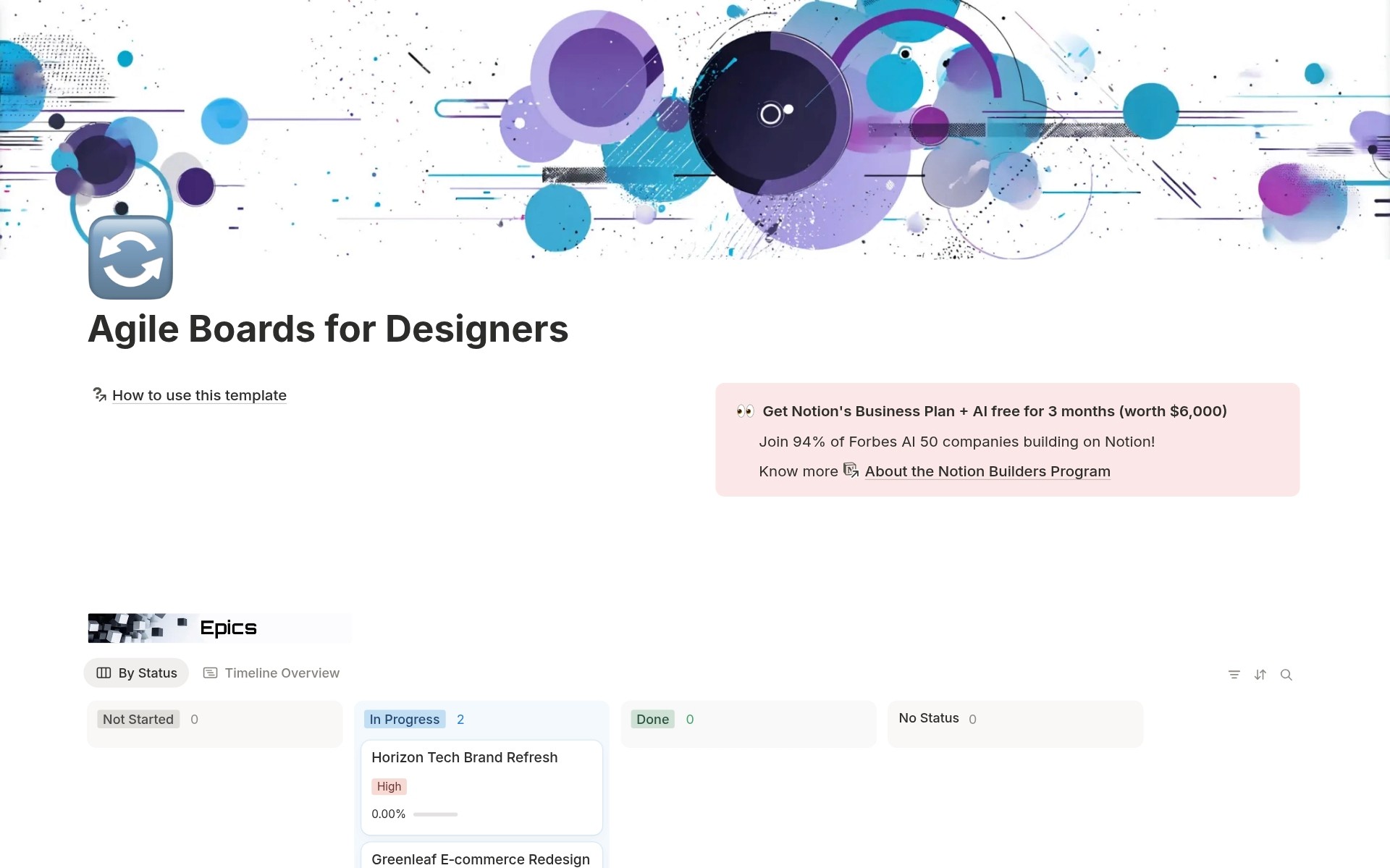
You run a design team. You need project management. You try Jira. It's built for engineers. Endless configuration. Terminology that doesn't match design work. Your team hates it. You try spreadsheets. Can't track relationships between epics, user stories, and tasks. No sprint planning. No retrospectives. Just static lists that get outdated immediately. You use Trello. It's too simple. Can't track story points, sprints, or design-specific workflows. No way to manage retrospective action items. No team member tracking. Too basic for serious design operations.
- Project management tools built for engineering teams that don't match design workflows - No systematic way to break design work into Epics, User Stories, and Tasks - Can't track story points or measure team velocity for design work - No sprint planning system adapted for design disciplines - Missing retrospective and action item tracking to improve the process - Can't organize by design tracks (Brand, Web, UI, UX, Illustration, Motion, Print, Social) - No Figma link integration or design-specific task types - Feeling like project management fights against design work instead of enabling it
Instead of Jira confusion or spreadsheet chaos, you organize design work through proper agile hierarchy, track by 8 design disciplines, manage sprints with design-focused workflows, run retrospectives with What Went Well/Challenges/Improvements, and track team capacity. Design operations become systematic, measurable, and improvable.
What´s Included
Design-Specific Organization
8 design disciplines (Brand, Web, UI, UX, Illustration, Motion, Print, Social) across Epics, User Stories, and Tasks. Organize work by design specialty, not engineering categories. Design-native taxonomy.
Design Review Workflow
Review rounds on Tasks. Design Status property on User Stories. Figma links. Design-specific workflows instead of generic development stages.
Complete Connected Hierarchy
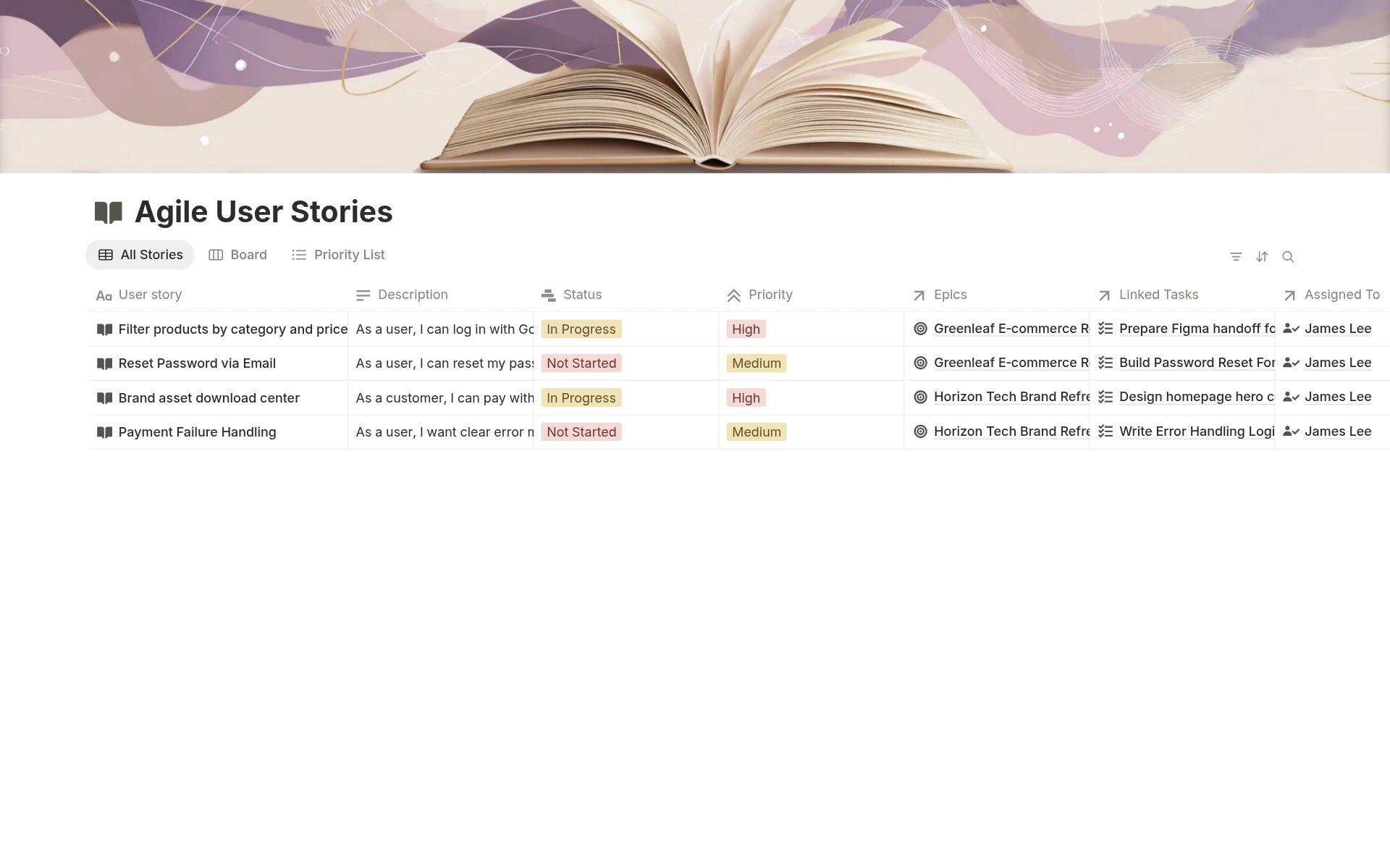
Epics → User Stories → Tasks. User Stories → Tasks → Sprints. Sprints → Retrospectives → Action Items. Action Items → Tasks. Everything links. Navigate from any level to related work. Complete traceability.
Retrospective and Improvement System
Structured retrospective template (What Went Well, Challenges, Improvements, Kudos). Sprint Health tracking (Green/Amber/Red). Action Items generated from retros with priority, owners, and due dates. Close the improvement loop.
How It Works
Create Tasks, Plan Sprints
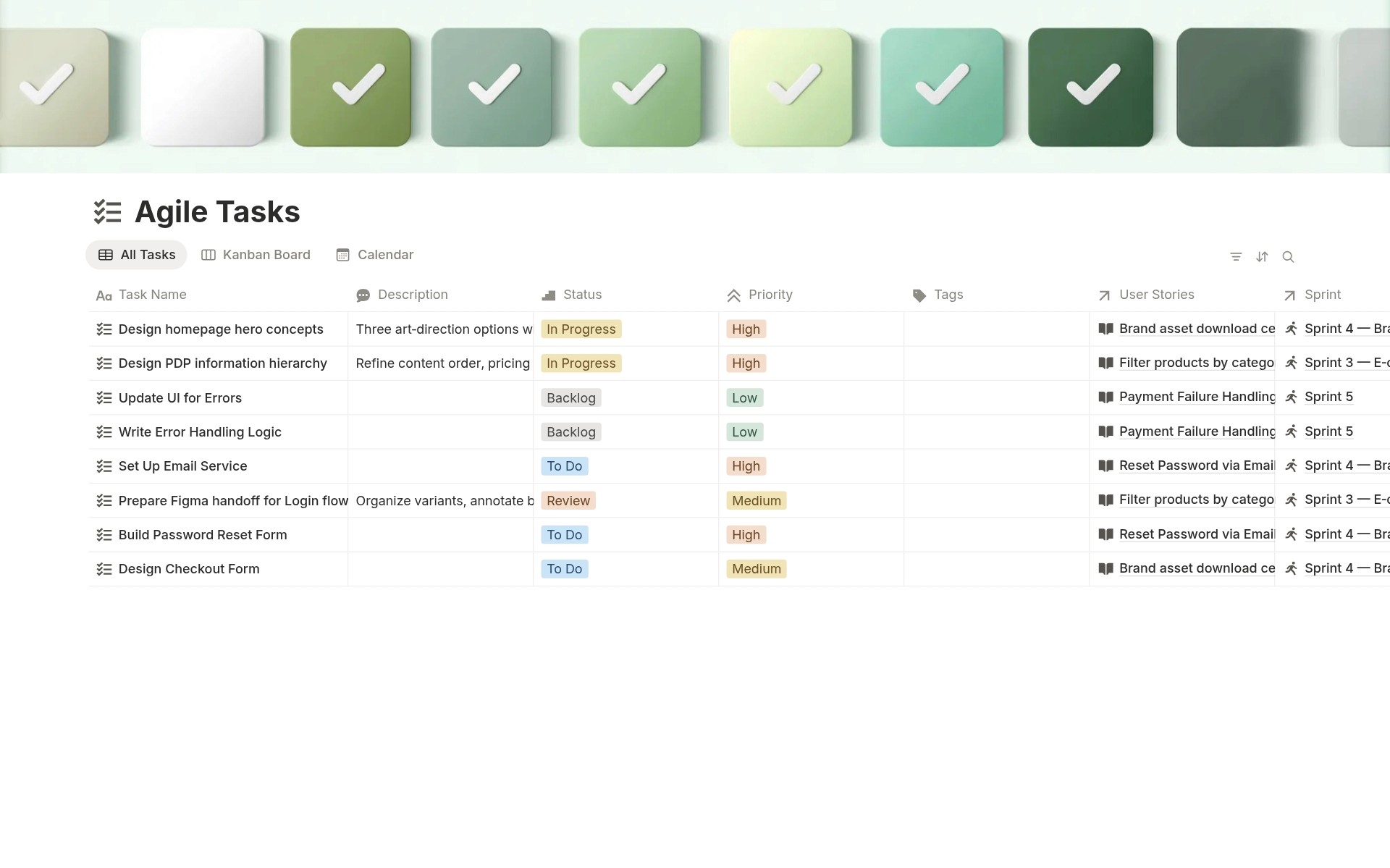
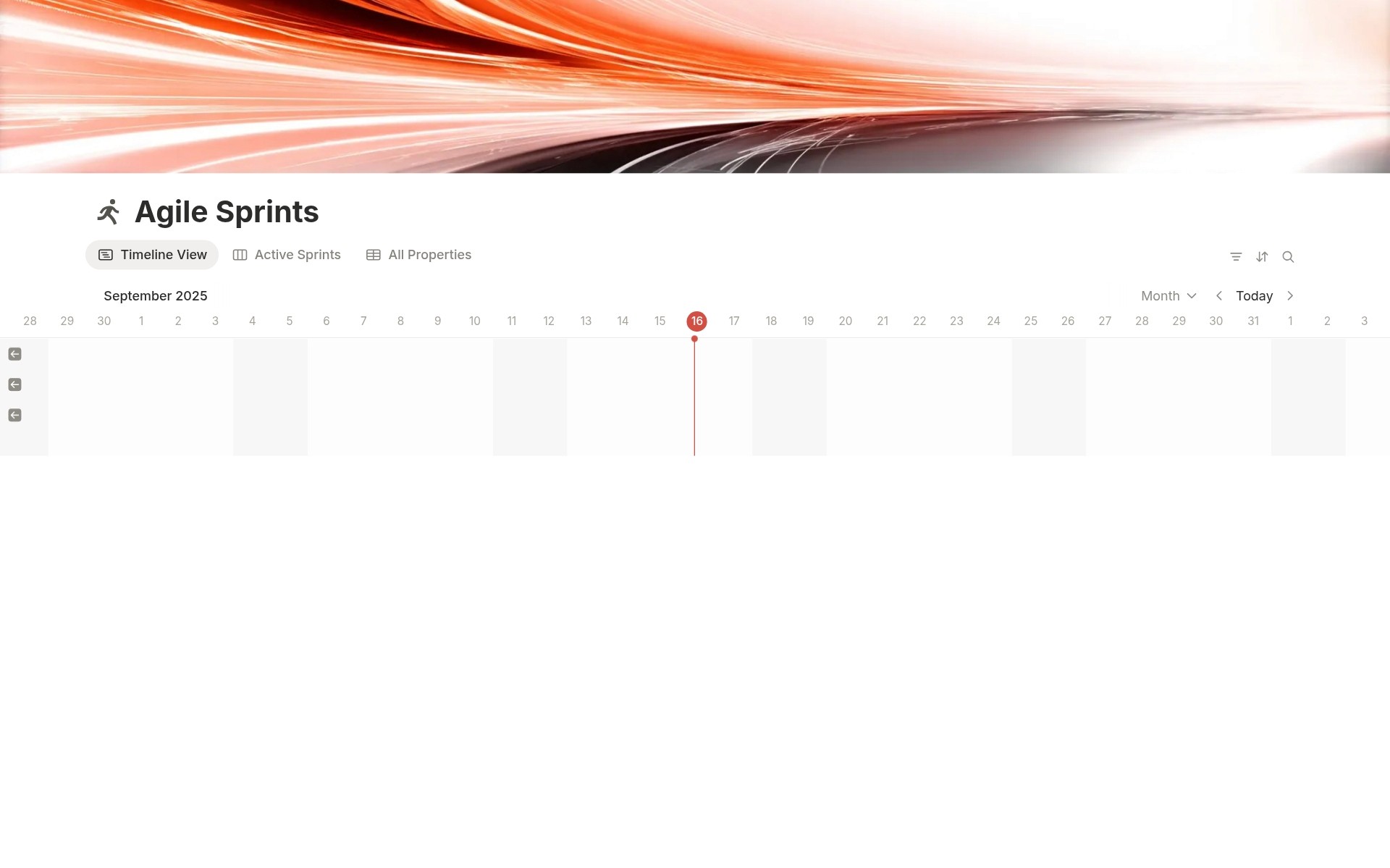
Break User Stories into tactical Tasks. Set Task Type, estimate hours, add Review Round, assign Team Members, and link to User Story. Create a sprint. Set goal, dates, and capacity. Link Tasks to Sprint. Assign Team Members. Sprint planning complete.
Execute and Track
Team works through Sprint Tasks. Update the status through the workflow. Log hours. Move through Review Rounds. Mark completed.
In 2 hours, you transform from chaotic design management to systematic agile operations.
Key Features
Design-Native Agile Hierarchy
Epics for Big Initiatives
Large design programs spanning multiple sprints. Brand refreshes. Website redesigns. Design system creation. Track at the initiative level with story points, timelines, and outcomes.
User Stories for Features
Specific design deliverables within epics. "Redesign PDP layout" or "Create brand guidelines." Track with story points, design status, Figma links, and acceptance criteria.
Tasks for Tactical Work
Actual design work. "Design 3 homepage hero concepts" or "Conduct usability testing." Track with hours, review rounds, and a detailed status workflow.
Story Points and Velocity
Story Points on User Stories
Estimate effort in story points (1, 2, 3, 5, 8, 13). Standard agile estimation for design work.
Epic Story Points Tracking
Story Points Planned and Story Points Done fields on Epics. Progress rollup shows completion percentage. Track initiative progress systematically.
Sprint Capacity and Velocity
Capacity (total team story points available). Velocity (story points actually completed). Measure team performance. Plan future sprints based on historical velocity.
Sprint Planning and Management
3-Status Sprint Workflow
Planning (preparing sprint), Active (currently running), Completed (finished). Clear sprint lifecycle.
Sprint Types
Design (design-only sprint), Dev (development-focused), Mixed (design + dev collaboration). Classify sprint focus.
Capacity Planning
Set the total team capacity in story points. Link Team Members to Sprint. Assign Tasks to Sprint. Know if the sprint is over/under committed.
Retrospective System
4-Part Retrospective Template
What Went Well (celebrate wins). Challenges (identify problems). Improvements (suggest solutions). Kudos (recognize team members). Structured reflection.
Sprint Health Rating
Green (healthy sprint), Amber (some issues), Red (serious problems). Quantify sprint quality beyond just velocity.
Team Participation
Link Team Members to Retrospectives. Track who participated. Ensure full team engagement in continuous improvement.
Action Item Management
5 Action Item Categories
Process (workflow improvements), Quality (output improvements), Communication (collaboration improvements), Delivery (shipping improvements), Tooling (tool adoption). Organize improvements by type.
Priority and Impact
Priority (High/Medium/Low) and Impact (High/Medium/Low) separate fields. Prioritize high-impact improvements.
Link Back to Tasks
When implementing action items, link to Tasks where changes are made. Complete traceability from retrospective insight through implementation.
Team Management
7 Design Roles
Design Lead, Product Designer, Brand Designer, UX Researcher, Project Manager, Developer, QA. Team structure matching design operations.
Workload Visibility
From Team Member, see the linked User Stories, Tasks, Sprints, Retrospectives, and Action Items. Understand each person's workload and participation.
Team Directory
Profile pics, contact info, locations, departments, reporting managers, joined dates, professional goals. Complete team information.
Perfect For
Design Teams and Studios
Running agile design operations and needing systematic project management without engineering overhead.
Product Design Teams
Working in sprints alongside engineering and needing design-specific agile workflows.
Creative Agencies
Managing multiple client projects with sprint-based delivery and team capacity tracking.
In-House Design Teams
Implementing agile methodologies adapted for design disciplines (Brand, Web, UI, UX, etc.).
Design Leaders and Managers
Tracking team velocity, conducting retrospectives, and improving design operations systematically.
Freelance Designers with Teams
Managing contractors and collaborators through structured sprint planning and task assignment.
Get Design-Native Agile.
Stop fighting engineering-focused tools. Get the complete agile system built specifically for design teams: 7 connected databases, design-native workflows, sprint planning, retrospectives, and velocity tracking. Your team will thank you.