Decision Journal
Make Better Decisions. Learn From Every Choice.
he complete decision-making system that helps you document choices, evaluate outcomes, and improve judgment over time without hindsight bias and repeated mistakes.
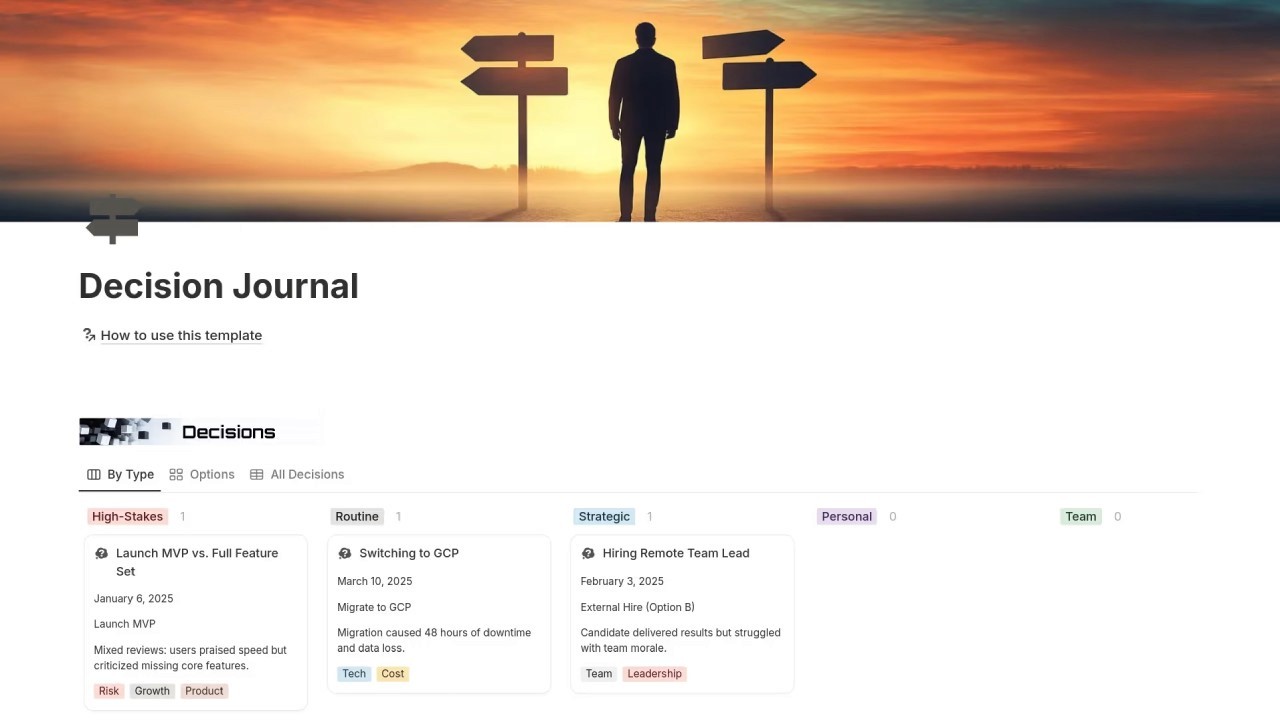
You make important decisions constantly. Hire this candidate or that one. Launch now or wait. Invest in this strategy or another. You weigh options, make choices, and move forward. Six months later, the decision fails. You think back. Why did that seem like a good idea? What did you miss? You can't remember your reasoning. You repeat the same mistake because you never analyzed what went wrong.
- Important decisions made without systematic documentation of reasoning - No record of what options you considered or why you chose one - Hindsight bias making you think bad outcomes were "obviously" predictable - Repeating the same decision-making mistakes because patterns aren't tracked - No systematic way to evaluate if decisions were good based on available information - Can't identify cognitive biases affecting your judgment - No learning feedback loop connecting decisions to outcomes to improvements - Making choices in a vacuum without building on past experience
Decision Journal transforms ad-hoc decision-making into a systematic learning process where every choice is documented before the outcome is known, evaluated after results are clear, and analyzed to improve future judgment. Instead of making decisions and forgetting your reasoning, you document context, options considered, the chosen option, and rationale before acting. After outcomes emerge, you evaluate what happened, identify cognitive biases, extract lessons learned, and calculate accuracy scores comparing pre-decision expectations to post-decision reality. Learn from every choice, systematically.
What´s Included
Decision Journal Database
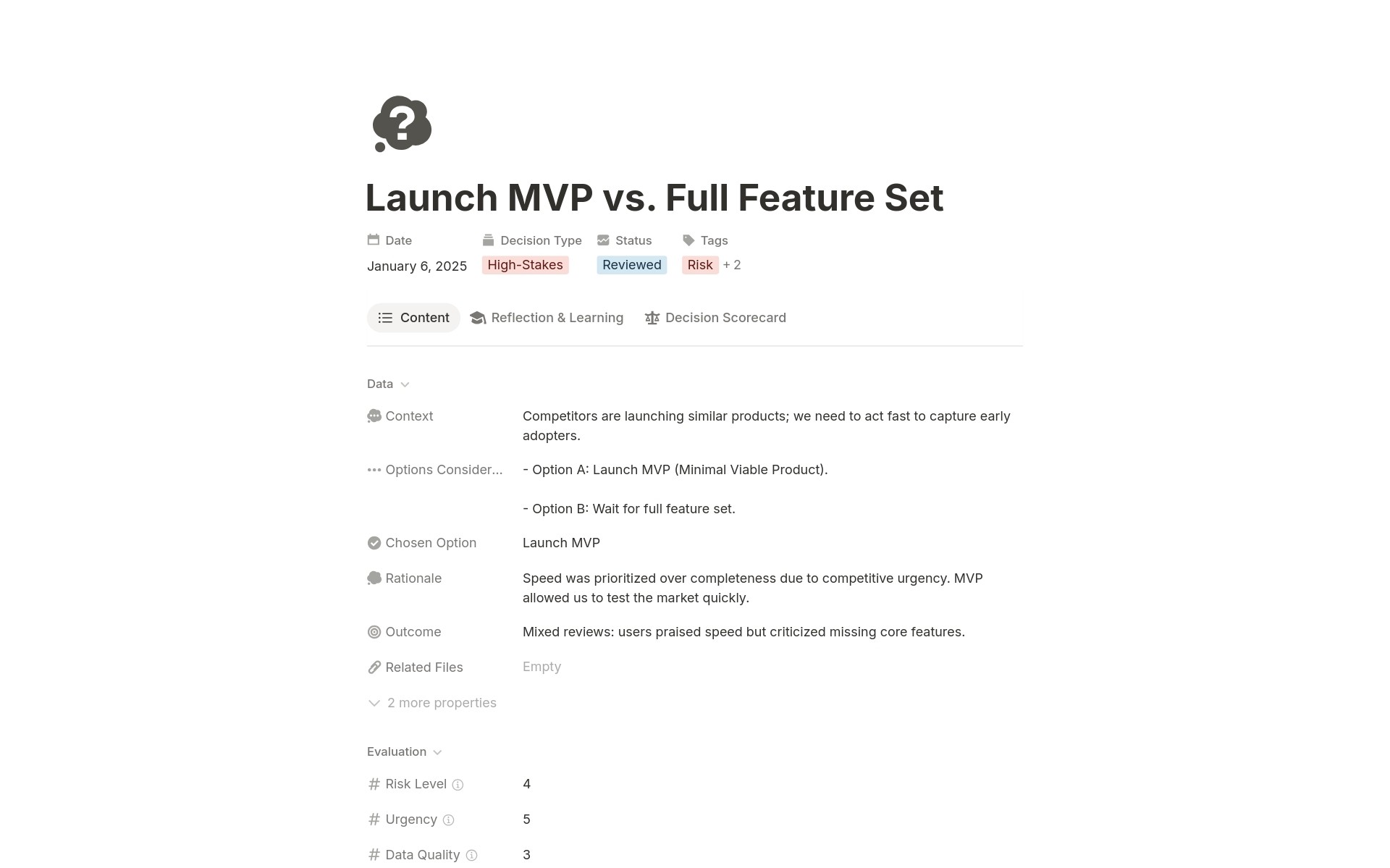
Document decisions with names, dates, context, options considered, chosen option, rationale, outcomes, decision types, status tracking, tags, and 5 pre-decision criteria scores. Built-in formula automatically calculates the Pre-Decision Criteria score.
Reflection & Learning Database
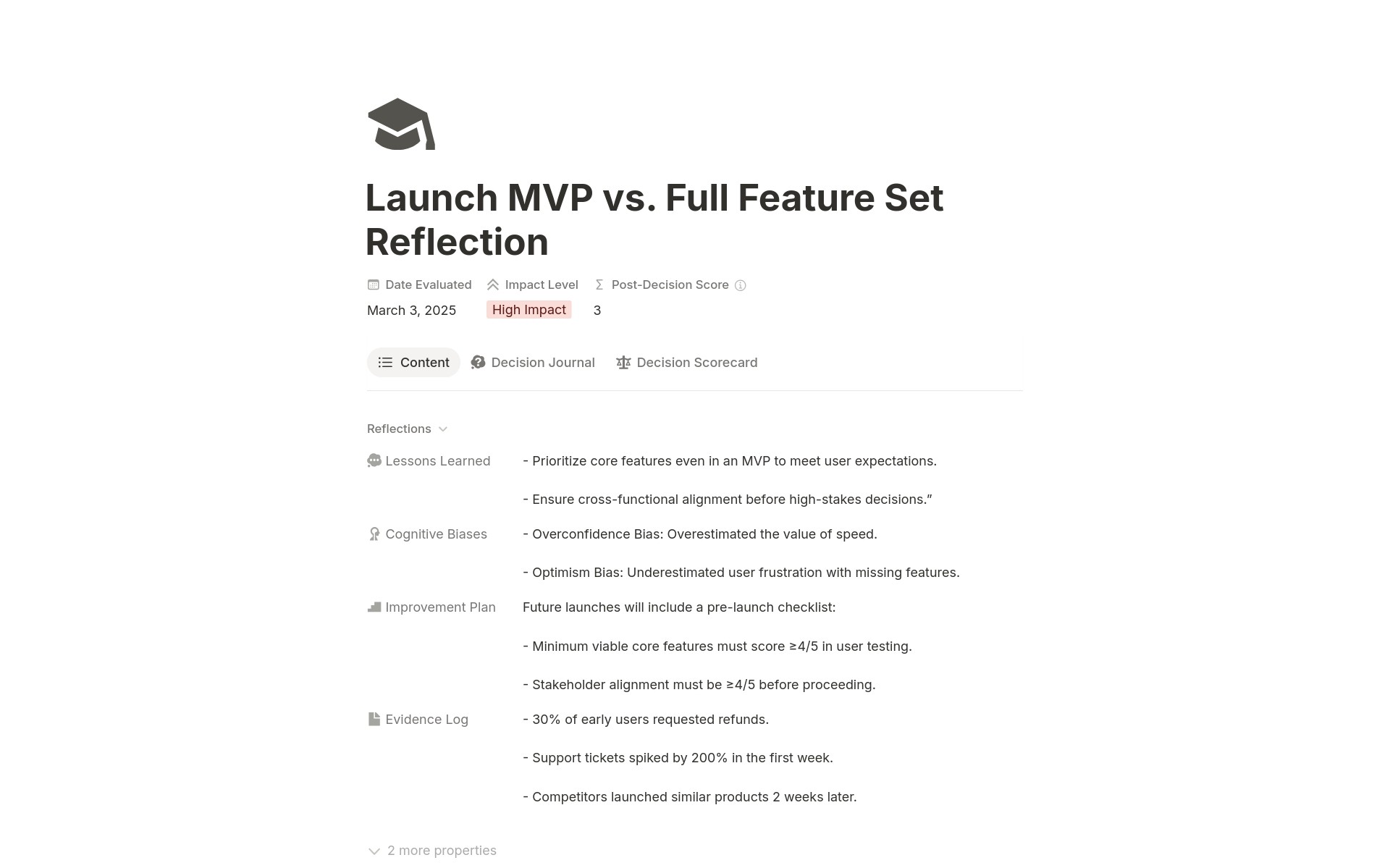
Evaluate decisions after outcomes are known with outcome quality scores, execution effectiveness ratings, stakeholder satisfaction measurements, learning gained assessments, cognitive biases identified, evidence logs, lessons learned, improvement plans, impact levels, and evaluation dates. Built-in formula automatically calculates Post-Decision Score.
Decision Scorecard Database
Automatically compare pre-decision expectations to post-decision reality with rollup formulas that pull Pre-Decision Score and Post-Decision Score, then calculate Accuracy Score, Bias Score, and Decision Validity. Identify patterns in your decision-making effectiveness.
Multiple Strategic Views
Decisions are organized by Type in the board view, the Options gallery view, and comprehensive All Decisions table. Reflections viewable by Cognitive Biases, Lessons & Improvements, and All Reflections table. Scorecards gallery for performance analysis.
Evidence-Based Learning
Document specific evidence supporting reflections. Track what actually happened (customer data lost, revenue impact, stakeholder feedback) rather than vague impressions. Build institutional memory.
Improvement Planning
Every reflection includes an improvement plan documentation. Transform lessons learned into concrete action items for future decision-making processes.
How It Works
Make Your Choice
Decide and act. Record your chosen option. The pre-decision documentation is now complete and can't be influenced by hindsight bias.
Observe the Outcome
Weeks or months later, after results are clear, update the Outcome field. What actually happened? Document factual results without interpretation yet.
In less than 15 minutes per decision, you build a systematic learning feedback loop that improves judgment over time.
Key Features
Systematic Decision Documentation
Pre-Decision Capture
Document decisions BEFORE outcomes are known. Record context, options considered, chosen option, and rationale while your thinking is fresh. Eliminate hindsight bias by capturing what you knew at decision time, not what you learned later.
5 Decision Types
Classify decisions as High-Stakes (critical business choices), Strategic (long-term direction), Team (collaborative decisions), Personal (individual choices), or Routine (operational). Filter and analyze different decision types separately.
Status Workflow
Track decisions from Pending (not yet made) through Completed (choice executed) to Reviewed (reflection completed). Know which decisions need follow-up evaluation.
Pre-Decision Criteria Scoring
5-Dimension Assessment
Rate every decision on five criteria before choosing: Risk Level (1=Low Risk, 5=High Risk), Data Quality (1=Poor Data, 5=High-Quality Data), Stakeholder Alignment (1=Misaligned, 5=Fully Aligned), Urgency (1=Not Urgent, 5=Immediate Action Required), Resource Availability (1=Scarce Resources, 5=Abundant Resources).
Automatic Pre-Decision Score
Built-in formula averages your 5 ratings into a Pre-Decision Criteria score. Quantify how favorable conditions were at decision time for later comparison to outcomes.
Decision Context Capture
Document context explaining the situation requiring a decision. When reviewing months later, understand the constraints and pressures that influenced your choice.
Post-Decision Evaluation
4-Dimension Outcome Measurement
Evaluate decisions after outcomes emerge across four criteria: Outcome Quality (1=Catastrophic, 5=Exceptional), Execution Effectiveness (1=Poor Execution, 5=Flawless Execution), Stakeholder Satisfaction (1=Dissatisfied, 5=Fully Satisfied), Learning Gained (1=No Learning, 5=Profound Insights).
Automatic Post-Decision Score
Built-in formula averages your 4 outcome ratings into a Post-Decision Score. Quantify actual results for comparison against pre-decision expectations.
Evidence Log Documentation
Record specific factual evidence supporting your evaluation. "30% of early users requested refunds" is more valuable than "users were unhappy." Build concrete learning based on data, not impressions.
Cognitive Bias Identification
Systematic Bias Recognition
Document which cognitive biases affected each decision: Overconfidence Bias (overestimating success probability), Optimism Bias (underestimating risks), Sunk Cost Fallacy (continuing because you've invested), Anchoring Bias (over-relying on first information), Confirmation Bias (seeking evidence supporting your preference).
Pattern Recognition Across Decisions
Review reflections filtered by cognitive biases. If Overconfidence Bias appears repeatedly, you have a systematic thinking flaw to address. Awareness enables correction.
Bias Gallery View
The dedicated view shows reflections organized by the cognitive biases identified. Study your bias patterns to improve future judgment.
Automated Performance Scorecards
Pre vs. Post Comparison
Scorecards automatically pull Pre-Decision Score from decision entries and Post-Decision Score from reflection entries through database rollups. See both scores side-by-side.
Accuracy Score Calculation
Built-in formula calculates the Accuracy Score by comparing pre-decision expectations to post-decision reality. High accuracy means your pre-decision assessment matched actual outcomes. Low accuracy indicates misjudgment.
Bias Score Calculation
The formula identifies whether you were overconfident (Pre-Decision Score higher than Post-Decision Score) or underconfident (Pre-Decision Score lower than Post-Decision Score). Systematic overconfidence indicates judgment calibration problems.
Lessons Learned Library
Structured Lesson Capture
Document lessons learned from every evaluated decision. Build institutional knowledge about what works, what doesn't, and why.
Improvement Plans
Every reflection includes improvement plan documentation. Transform insights into concrete actions: "Future launches will include a pre-launch checklist with minimum viable core features scoring ≥4/5 in user testing."
Lessons & Improvements View
Dedicated gallery view shows lessons learned and improvement plans from all reflections. Review before making similar decisions to avoid repeating mistakes.
Connected Learning Loop
Three-Way Database Relations
Decisions link to reflections. Reflections link to scorecards. Scorecards link back to both decisions and reflections. Navigate the complete decision lifecycle from any entry point.
Automatic Data Flow
Scorecards automatically pull pre-decision criteria scores and post-decision scores through rollup properties. No manual data entry. Formulas calculate accuracy and bias metrics instantly.
Complete Decision History
From a decision entry, see the linked reflection and scorecard. From a scorecard, navigate back to the original decision and reflection. Complete context is always available.
Perfect For
Business Leaders and Executives
Making high-stakes strategic decisions regularly and wanting to improve judgment through systematic reflection and learning.
Entrepreneurs and Founders
Navigating constant uncertainty and needing to learn from both successes and failures to make better choices as companies grow.
Product Managers
Making product decisions (build vs. buy, feature prioritization, launch timing) and wanting data-driven improvement in decision-making.
Investors and Traders
Evaluating opportunities and needing systematic processes to reduce cognitive biases and improve batting averages over time
Team Leaders and Managers
Making people decisions (hiring, promotions, terminations) and wanting to identify patterns in judgment to build stronger teams.
Anyone Serious About Self-Improvement
Committed to becoming a better decision-maker through deliberate practice, systematic reflection, and evidence-based learning.
Stop Forgetting. Start Learning.
Decision Journal captures your reasoning before outcomes are known, evaluates results after they're clear, and calculates accuracy scores that reveal systematic biases in your judgment. Are you ready to stop repeating decision-making mistakes and start building a systematic learning feedback loop?